
Preparing for your biology midterm? This guide offers a comprehensive review, covering key concepts from cellular processes to ecological principles, ensuring success!
Resources like NJCTL and practice question videos can significantly enhance your understanding and exam performance.
Remember animal cells lack cell walls, impacting water potential calculations, and understanding this is crucial for exam success.
Biology, the study of life, begins with a systematic approach – the scientific method. This process involves observation, forming a hypothesis, conducting experiments, analyzing data, and drawing conclusions. Understanding these steps is fundamental for interpreting biological phenomena.
A crucial aspect is differentiating between independent and dependent variables, alongside recognizing control groups for accurate comparisons. The ability to formulate a testable hypothesis is paramount.
Furthermore, grasp the concepts of qualitative versus quantitative data, and the importance of sample size in ensuring reliable results.
Remember, scientific theories are well-substantiated explanations, not mere guesses, built upon repeated experimentation and observation.
Finally, consider the ethical implications of biological research and the importance of peer review in validating scientific findings. Mastering these foundational principles will set a strong base for further study.
II. Basic Chemistry for Biology
Life’s chemical basis relies on understanding atoms, molecules, and chemical bonds. Key concepts include electronegativity, polarity, and the different types of chemical bonds – ionic, covalent, and hydrogen. These bonds dictate how molecules interact and function within living systems.
Water, a polar molecule, exhibits unique properties like cohesion, adhesion, high specific heat, and its ability to act as a universal solvent. These properties are essential for life.
pH, measuring acidity and alkalinity, is critical as biological processes are sensitive to pH changes. Buffers maintain stable pH levels.
Understanding the relationship between structure and function at the molecular level is vital.
Finally, remember that biological molecules are built from smaller subunits, and their arrangement determines their properties and roles within cells. A solid grasp of these chemical principles is foundational for understanding biological processes.
A. Water & Its Properties
Water is arguably the most important molecule for life. Its polarity allows for hydrogen bonding, leading to unique properties crucial for biological systems. Cohesion, the attraction between water molecules, creates surface tension and aids in transport in plants.
Adhesion, attraction to other surfaces, contributes to capillary action. Water’s high specific heat capacity stabilizes temperatures, resisting drastic changes. This is vital for maintaining homeostasis in organisms and aquatic environments.
Water’s high heat of vaporization provides a cooling mechanism through evaporation.
Its excellent solvent capabilities allow for the transport of nutrients and removal of waste. Understanding water potential, especially pressure potential in animal cells (often zero due to the lack of cell walls), is essential for exam questions.
B. Macromolecules (Carbohydrates, Lipids, Proteins, Nucleic Acids)
Life’s building blocks are macromolecules: carbohydrates, lipids, proteins, and nucleic acids. Carbohydrates provide energy (sugars, starches) and structural support (cellulose). Lipids store energy (fats, oils), form cell membranes (phospholipids), and act as hormones (steroids).
Proteins have diverse functions – enzymes catalyze reactions, structural proteins provide support, and transport proteins carry molecules. Their structure is determined by amino acid sequence.
Nucleic acids (DNA and RNA) store and transmit genetic information. DNA contains the instructions for building proteins, while RNA plays a role in protein synthesis.
Understanding the monomers (building blocks) of each macromolecule and their respective functions is critical for the midterm. Focus on how structure dictates function!
III. Cell Structure & Function
Cells are the fundamental units of life! Understanding their structure is key. Prokaryotic cells (bacteria, archaea) lack a nucleus and other membrane-bound organelles, while eukaryotic cells (plants, animals, fungi) possess them.

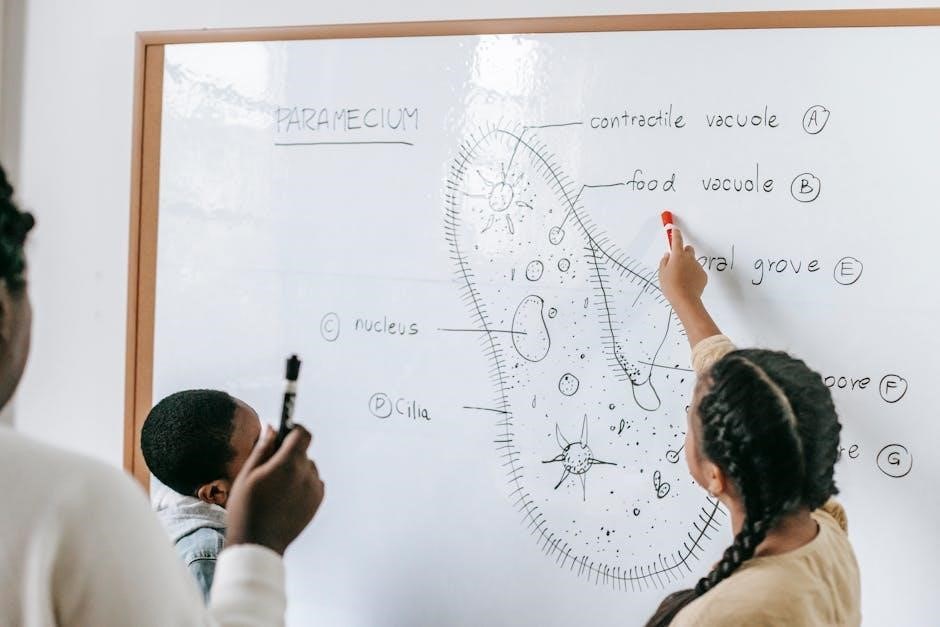
Key organelles include the nucleus (control center), mitochondria (energy production), ribosomes (protein synthesis), and the endoplasmic reticulum & Golgi apparatus (protein processing & transport).
The cell membrane, composed of a phospholipid bilayer, regulates what enters and exits the cell. Transport mechanisms include diffusion (passive, high to low concentration), osmosis (water diffusion), and active transport (requires energy).
Mastering the functions of each organelle and the principles of membrane transport will be crucial for success on the midterm exam.
A. Prokaryotic vs. Eukaryotic Cells
The first major division in cell types lies between prokaryotic and eukaryotic structures. Prokaryotic cells, representing the earliest life forms, are simpler and smaller. They lack a true nucleus; their genetic material resides in a nucleoid region without a membrane.
Crucially, prokaryotes also lack other membrane-bound organelles like mitochondria or endoplasmic reticulum. Bacteria and archaea are examples of prokaryotic cells.
Eukaryotic cells, found in plants, animals, fungi, and protists, are significantly more complex. They possess a true nucleus, housing their DNA, and a variety of membrane-bound organelles, each with specialized functions.
Understanding these fundamental differences – presence/absence of a nucleus and organelles – is vital for grasping cellular biology and will be heavily tested on the midterm.
B. Organelles & Their Functions (Nucleus, Mitochondria, Ribosomes, etc.)
Eukaryotic cells are defined by their compartmentalization via organelles. The nucleus controls cellular activities, housing DNA. Mitochondria are the “powerhouses,” generating ATP through cellular respiration – a key process for energy.
Ribosomes are responsible for protein synthesis; they can be free-floating or bound to the endoplasmic reticulum. The endoplasmic reticulum (ER) – rough (with ribosomes) and smooth – plays roles in protein and lipid synthesis.
The Golgi apparatus processes and packages proteins. Lysosomes contain enzymes for intracellular digestion. Understanding the specific function of each organelle, and how they interact, is crucial.
A strong grasp of organelle roles will be essential for success on the biology midterm, particularly when analyzing cellular processes and dysfunctions.
C. Cell Membrane & Transport (Diffusion, Osmosis, Active Transport)
The cell membrane regulates what enters and exits the cell. Diffusion is the movement of molecules from high to low concentration, requiring no energy. Osmosis, a specific type of diffusion, focuses on water movement across a semi-permeable membrane.
Active transport, however, requires energy (ATP) to move substances against their concentration gradient. This is vital for maintaining cellular homeostasis. Understanding water potential, especially in animal cells (which lack cell walls and thus have zero pressure potential), is critical.
Factors like solute concentration and pressure influence water movement. Mastering these transport mechanisms – diffusion, osmosis, and active transport – is fundamental for the biology midterm.
Be prepared to apply these concepts to various scenarios and analyze their impact on cellular function.
IV. Cellular Energetics
Cellular energetics focuses on how cells obtain and utilize energy. Photosynthesis converts light energy into chemical energy (glucose), occurring in two stages: light-dependent reactions and the Calvin cycle. The light-dependent reactions capture energy, while the Calvin cycle uses it to fix carbon dioxide.
Cellular respiration breaks down glucose to release energy in the form of ATP. This process includes glycolysis, the Krebs cycle (Citric Acid Cycle), and the electron transport chain & oxidative phosphorylation.
Each stage plays a crucial role in maximizing ATP production. Understanding the interconnectedness of these pathways and their locations within the cell is essential. Prepare to compare and contrast photosynthesis and cellular respiration for the midterm.
A. Photosynthesis
Photosynthesis is the remarkable process by which plants and other organisms convert light energy into chemical energy in the form of glucose. This vital process sustains most life on Earth, and understanding its intricacies is crucial for the biology midterm.
Photosynthesis unfolds in two main stages: the light-dependent reactions and the Calvin cycle. The light-dependent reactions, occurring in the thylakoid membranes, capture solar energy and transform it into chemical energy carriers like ATP and NADPH.
Subsequently, the Calvin cycle, taking place in the stroma, utilizes this energy to fix carbon dioxide from the atmosphere, ultimately producing glucose. Be prepared to detail the inputs, outputs, and locations of each stage.
Light-Dependent Reactions
The light-dependent reactions are the initial phase of photosynthesis, occurring within the thylakoid membranes of chloroplasts. These reactions harness light energy to generate ATP and NADPH, essential for the subsequent Calvin cycle.
This process begins with the absorption of light by chlorophyll and other pigments, exciting electrons. These energized electrons move through an electron transport chain, releasing energy used to pump protons (H+) into the thylakoid lumen, establishing a proton gradient.
This gradient drives ATP synthase, producing ATP through chemiosmosis. Simultaneously, water molecules are split (photolysis), replenishing electrons and releasing oxygen as a byproduct. NADPH is formed when electrons combine with NADP+. Understanding electron flow is key!
Calvin Cycle
The Calvin cycle, also known as the light-independent reactions, takes place in the stroma of the chloroplasts. It utilizes the ATP and NADPH generated during the light-dependent reactions to fix carbon dioxide (CO2) into organic molecules, ultimately producing glucose.
The cycle begins with carbon fixation, where CO2 combines with ribulose-1,5-bisphosphate (RuBP), catalyzed by the enzyme RuBisCO. This unstable intermediate quickly breaks down into two molecules of 3-phosphoglycerate (3-PGA).
ATP and NADPH are then used to convert 3-PGA into glyceraldehyde-3-phosphate (G3P). Some G3P is used to create glucose, while the rest regenerates RuBP, allowing the cycle to continue. Mastering the steps and inputs/outputs is vital for exam success!
B. Cellular Respiration
Cellular respiration is the process by which cells break down glucose to release energy in the form of ATP. It’s a multi-step process occurring in both the cytoplasm and mitochondria, essential for life’s functions.
The process begins with Glycolysis in the cytoplasm, splitting glucose into pyruvate and yielding a small amount of ATP and NADH. Next, pyruvate enters the mitochondria for the Krebs Cycle (Citric Acid Cycle), producing more NADH, FADH2, and a little ATP, releasing CO2 as a byproduct.
Finally, the Electron Transport Chain & Oxidative Phosphorylation utilize the electron carriers to generate a proton gradient, driving ATP synthase to produce the majority of ATP. Understanding each stage and its location is crucial for the midterm!
Glycolysis
Glycolysis, meaning “sugar splitting,” is the initial stage of cellular respiration, occurring in the cytoplasm. This anaerobic process doesn’t require oxygen to begin breaking down glucose, a six-carbon sugar, into two molecules of pyruvate, a three-carbon molecule.
During this process, a small net gain of ATP (2 molecules) is produced, alongside NADH, an electron carrier. Glycolysis can be divided into two phases: the energy-investment phase, which consumes ATP, and the energy-payoff phase, which generates ATP and NADH.
Understanding the inputs (glucose, ATP, NAD+) and outputs (pyruvate, ATP, NADH) of glycolysis is vital for the midterm; Remember, it sets the stage for further respiration if oxygen is present!
Krebs Cycle (Citric Acid Cycle)
The Krebs Cycle, also known as the Citric Acid Cycle, is a series of chemical reactions central to all aerobic organisms. This cycle takes place in the mitochondrial matrix, following glycolysis and before the electron transport chain. Pyruvate, produced during glycolysis, is first converted into Acetyl-CoA, which then enters the cycle.
Through a cyclical series of reactions, Acetyl-CoA is broken down, releasing carbon dioxide and generating high-energy electron carriers – NADH and FADH2 – along with a small amount of ATP. The Krebs Cycle doesn’t directly utilize oxygen, but it requires oxygen to continue as it regenerates the molecules needed to start the cycle again.
For the midterm, focus on understanding the cycle’s inputs, outputs, and its role in preparing for oxidative phosphorylation.
Electron Transport Chain & Oxidative Phosphorylation
The Electron Transport Chain (ETC) and Oxidative Phosphorylation represent the final stages of cellular respiration, occurring across the inner mitochondrial membrane; NADH and FADH2, generated during glycolysis, the Krebs cycle, deliver high-energy electrons to protein complexes within the ETC.
As electrons move down the chain, energy is released, pumping protons (H+) into the intermembrane space, creating an electrochemical gradient. This gradient drives ATP synthase, an enzyme that phosphorylates ADP to produce ATP – a process called chemiosmosis. Oxygen serves as the final electron acceptor, forming water.
For the midterm, understand how the ETC couples electron transfer to ATP synthesis, and the critical role of oxygen. Mastering this process is vital for understanding energy production in cells.
V. Cell Communication & Cell Cycle
Cell communication is essential for coordinating cellular activities, relying on signaling pathways that involve reception, transduction, and response. These pathways allow cells to react to their environment and each other, maintaining homeostasis. Understanding different signaling types – direct contact, paracrine, endocrine – is crucial.
The cell cycle consists of interphase (G1, S, G2 phases) and the mitotic (M) phase (mitosis and cytokinesis). Mitosis produces identical daughter cells, while meiosis generates genetically diverse gametes.
For the midterm, focus on the phases of the cell cycle, the checkpoints regulating progression, and the consequences of errors. Be prepared to differentiate between mitosis and meiosis, and explain the importance of cell signaling.
A. Cell Signaling Pathways
Cell signaling pathways are the mechanisms cells use to communicate, involving three key steps: reception, transduction, and response. Reception occurs when a signaling molecule binds to a receptor protein, often on the cell surface. Transduction involves a cascade of molecular interactions that relay the signal, frequently amplifying it.
Common second messengers like cyclic AMP (cAMP) and calcium ions play vital roles in transduction. The final response can vary widely, including altered gene expression or enzyme activity.

For the midterm, understand the major types of signaling (paracrine, endocrine, autocrine, direct contact) and the roles of receptors. Be prepared to explain how signaling pathways can be disrupted, leading to disease.
B. Phases of the Cell Cycle (Mitosis & Meiosis)
The cell cycle consists of interphase (G1, S, G2 phases) and the mitotic (M) phase. Mitosis, crucial for growth and repair, involves prophase, metaphase, anaphase, and telophase, resulting in two identical daughter cells. Understanding chromosome behavior during each phase is key.
Meiosis, essential for sexual reproduction, comprises Meiosis I and Meiosis II, producing four genetically diverse haploid gametes. Key events include crossing over in Prophase I, increasing genetic variation.
For the midterm, differentiate between mitosis and meiosis, focusing on chromosome number and genetic outcomes. Be prepared to explain the significance of each phase and potential errors that can occur during cell division.
VI. Genetics & Heredity
Genetics explores the principles of inheritance and variation. Mendelian genetics, foundational to the field, utilizes Punnett squares to predict offspring genotypes and phenotypes based on dominant and recessive alleles. Understanding concepts like homozygous, heterozygous, and genotype/phenotype distinctions is vital.
DNA structure, a double helix, dictates heredity. Replication ensures accurate DNA copying before cell division. Know the roles of key enzymes involved in replication and the base-pairing rules (A-T, C-G).
For the midterm, practice solving genetics problems using Punnett squares and be prepared to explain the process of DNA replication. Focus on how genetic information is transmitted from parents to offspring.
A. Mendelian Genetics (Punnett Squares, Dominance, Recessiveness)
Mendelian genetics, the cornerstone of heredity, focuses on predictable inheritance patterns. Dominant alleles express their trait even with one copy, while recessive alleles require two copies for expression. Understanding these concepts is crucial for predicting offspring traits.
Punnett squares are essential tools for visualizing all possible allele combinations from a cross. Practice constructing and interpreting Punnett squares for monohybrid and dihybrid crosses. Key terms include genotype (genetic makeup) and phenotype (observable traits).
Be prepared to define terms like homozygous, heterozygous, and allele. Master the ability to determine probabilities of specific genotypes and phenotypes appearing in offspring. This section heavily emphasizes problem-solving skills.
B. DNA Structure & Replication
Deoxyribonucleic acid (DNA) is the blueprint of life, possessing a distinctive double helix structure. Understand the components: nucleotides (sugar, phosphate, nitrogenous base – Adenine, Thymine, Guanine, Cytosine), and the base pairing rules (A with T, G with C). Knowing the scientists involved in its discovery is also beneficial.
DNA replication is the process of creating an identical copy of DNA. Focus on the roles of key enzymes like DNA polymerase, helicase, and ligase. Understand the concept of semi-conservative replication – each new DNA molecule contains one original and one new strand.
Be prepared to explain the steps of replication: initiation, elongation, and termination. Familiarize yourself with leading and lagging strands, and the significance of Okazaki fragments.
VII. Ecology
Ecology explores the interactions between organisms and their environment. Begin with population ecology, understanding factors influencing population size – birth rates, death rates, immigration, and emigration. Learn about population growth models (exponential and logistic) and carrying capacity.
Next, delve into ecosystems and energy flow. Grasp the concepts of trophic levels (producers, consumers, decomposers) and food webs. Understand how energy flows through an ecosystem, remembering the 10% rule – only about 10% of energy is transferred to the next level.
Be prepared to discuss biogeochemical cycles (water, carbon, nitrogen) and their importance. Consider the impact of human activities on these cycles and ecosystem health.
A. Population Ecology

Population ecology focuses on how and why populations change over time. Key concepts include population size, density, and distribution patterns (clumped, uniform, random). Understand factors regulating population growth: birth and death rates, immigration and emigration.
Explore different growth models: exponential growth occurs with unlimited resources, while logistic growth considers carrying capacity – the maximum population size an environment can sustain. Learn to interpret population growth curves.
Density-dependent and density-independent limiting factors also play crucial roles. Competition, predation, and disease are density-dependent, while natural disasters are density-independent. Be prepared to analyze scenarios involving these factors and their impact on population dynamics.
B. Ecosystems & Energy Flow
Ecosystems encompass all living organisms and their physical environment, focusing on energy transfer and nutrient cycling. Understand the roles of different trophic levels: producers (autotrophs), consumers (heterotrophs – primary, secondary, tertiary), and decomposers.
Energy flow is unidirectional, starting with solar energy captured by producers through photosynthesis. Only about 10% of energy is transferred to the next trophic level – the 10% rule – explaining why food chains are relatively short.
Explore food webs, which represent interconnected feeding relationships, offering a more realistic view than simple food chains. Nutrient cycles (carbon, nitrogen, water) are essential for ecosystem sustainability, involving biotic and abiotic components. Be prepared to analyze energy pyramids and understand the implications of energy loss at each level.